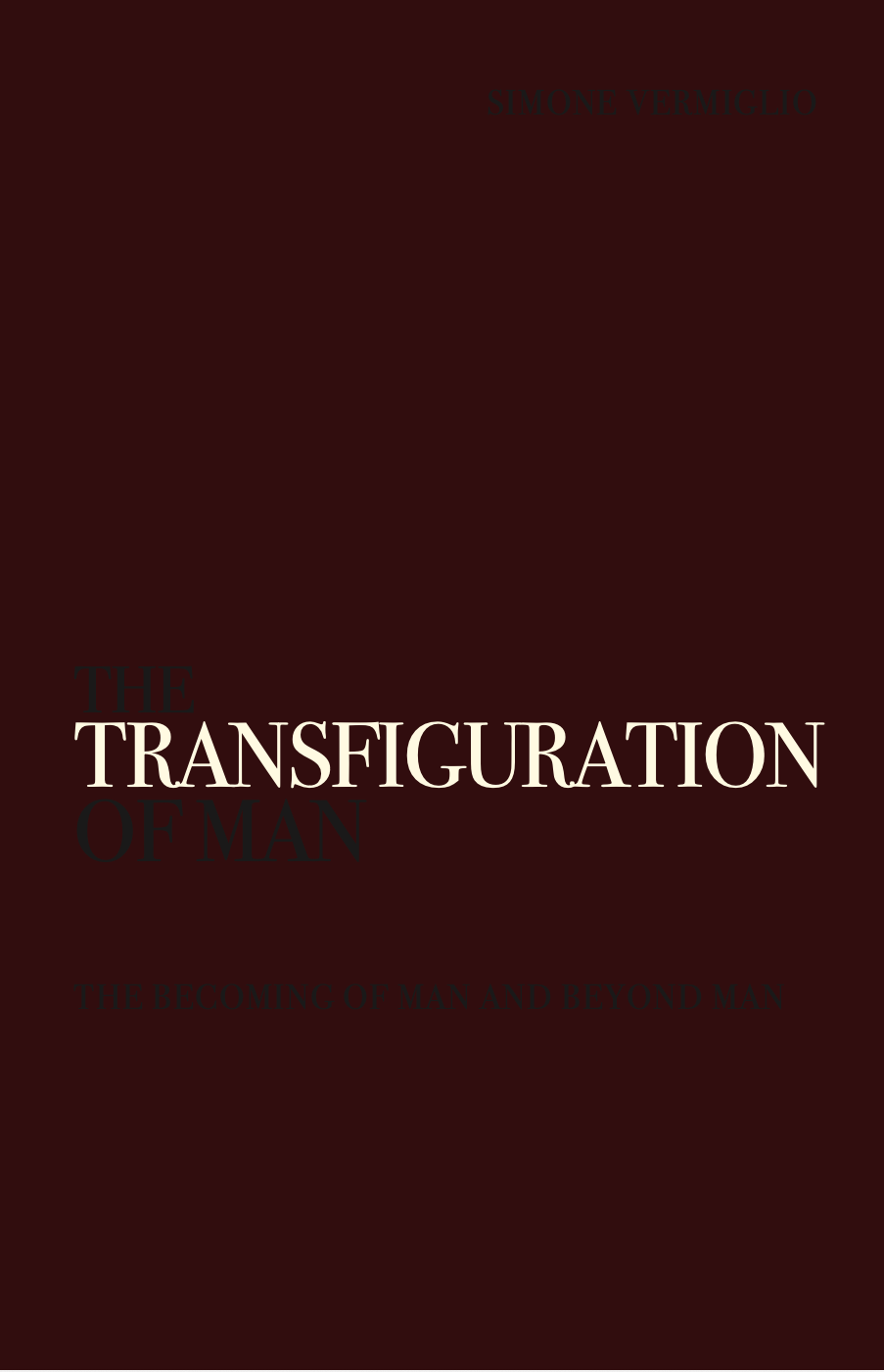
THE
TRANFIGURATION
OF MAN
THE BECOMING OF MAN AND BEYOND MAN
What is the furthest a
man can become?
Most books teach you how to become more successful, disciplined, confident or fulfilled.
This book asks what happens when none of that is enough.WHAT IF YOU COULD STRIP AWAY EVERYTHING THE WORLD TAUGHT YOU TO BE — AND DISCOVER WHO REMAINS?
WHAT IF YOU COULD STAND COMPLETELY ALONE — UNMOVED BY APPROVAL, REJECTION, OR THE FEAR OF BEING FORGOTTEN?
WHAT IF YOU COULD MASTER YOUR MIND SO COMPLETELY THAT YOUR LIFE CEASED TO HAPPEN TO YOU — AND BECAME SOMETHING YOU CONSCIOUSLY CREATED?
WHAT IF YOU COULD LOVE WITHOUT LOSING YOURSELF, DESIRE WITHOUT BECOMING ITS SLAVE, AND FACE THE BEAST WITHIN YOU WITHOUT LETTING IT RULE?
FREE FROM THE WORLD.
SOVEREIGN OF YOURSELF.
MASTER OF YOUR LIFE.
MASTER OF YOUR DESIRE.
YOU HAVE BECOME ALL THAT MAN
CAN BECOME BY HIS OWN STRENGTH.WOULD YOU HAVE THE COURAGE
TO GO BEYOND HIM?
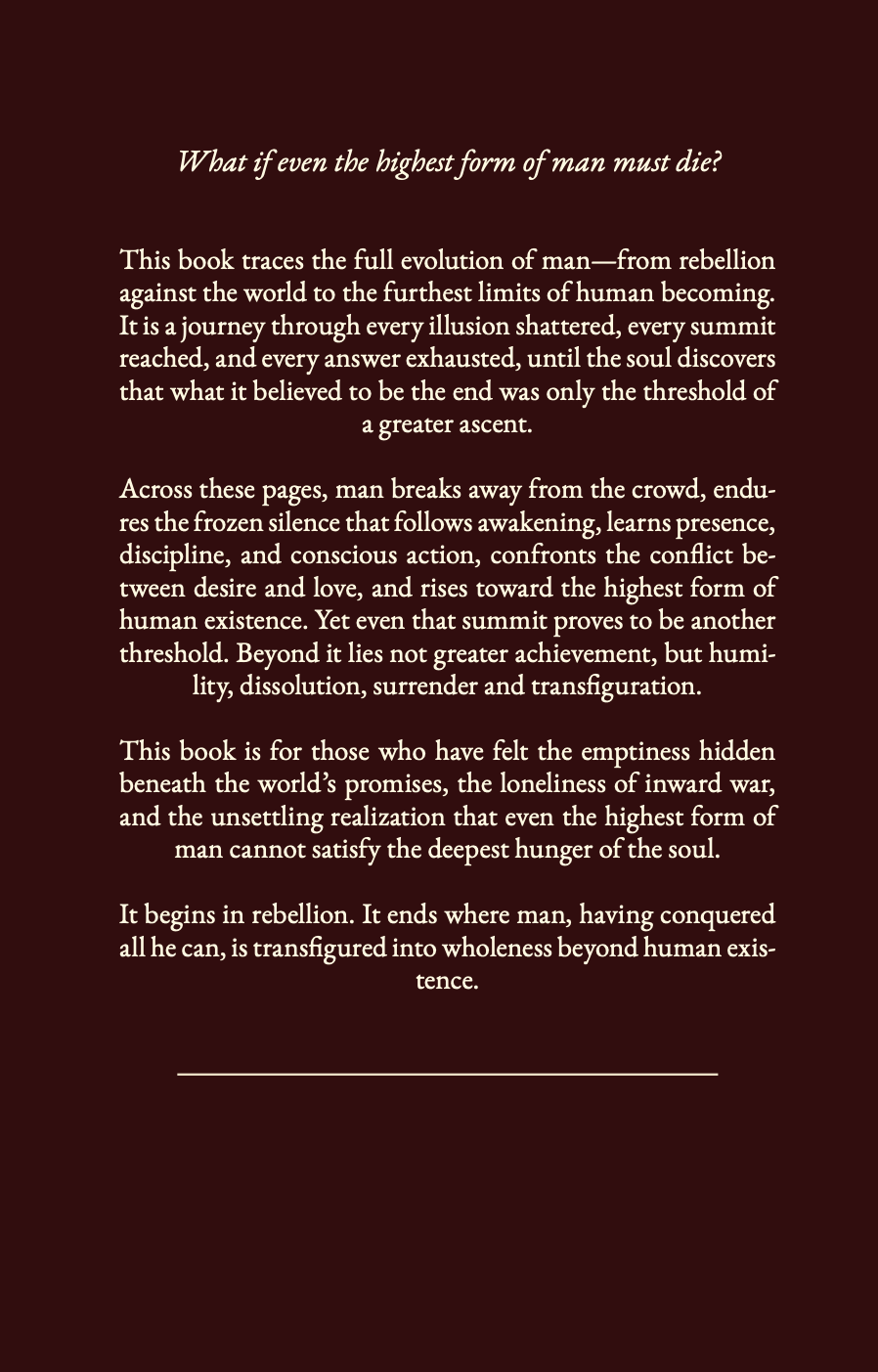
And there, where man has reached the highest point of his own becoming and can rise no further by his own force, the journey finds its final meaning — not in the triumph of the ego, but in its return to God.
Simone Vermiglio
ABOUT THE BOOK
HOW FAR CAN A HUMAN BEING CONSCIOUSLY TRANSFORM HIMSELF?
THE TRANSFIGURATION OF MAN is an inquiry into how far a human being can consciously transform himself, what such transformation demands, and whether the highest form of human becoming is truly the end of the journey.
MAN DOES NOT ENTER LIFE AS THE CONSCIOUS AUTHOR OF HIMSELF.
Before he possesses the awareness to question what surrounds him, the world has already begun to shape what he should pursue, what he should fear, what makes him worthy, and ultimately what kind of man he believes he ought to become.
The deepest forms of conditioning do not remain outside him as visible commands. They become internal enough to be mistaken for identity, until what has been inherited is experienced as what has been chosen.
WHAT WOULD IT MEAN TO BECOME THE CONSCIOUS AUTHOR OF YOUR BECOMING?
The work follows man as he becomes conscious of his own formation and begins to participate deliberately in what he becomes.
But it refuses the easier conclusion that freedom consists merely in rejecting society, just as it refuses to equate transformation with becoming harder, more disciplined, more successful, or more powerful.
A man can escape one form of unconsciousness and construct another within himself.
THIS IS NOT SIMPLY AN ASCENT TOWARD STRENGTH.
It is an attempt to bring the whole of man into consciousness.
The journey moves through inherited identity, rebellion, isolation, consciousness, discipline, power, desire, love and self-mastery — carrying each transformation far enough for both its power and its limits to become visible.
The aim is not to produce an invulnerable man, but to follow human becoming to the furthest point at which consciousness, lucidity, discipline, desire, love and will can transform the person who possesses them.
BUT WHAT HAPPENS IF HE SUCCEEDS?
If man becomes conscious of what once governed him, deliberately shapes the self that was once shaped without his awareness, confronts the depths of his own desire, and reaches the highest order available within his human nature — has he completed his transformation?
OR HAS HE MERELY REACHED THE LIMIT OF WHAT MAN CAN DO TO MAN?
Because there may come a point at which further ascent cannot be achieved by strengthening the same self that has been ascending.
A boundary at which greater discipline, greater control, greater knowledge, and even greater self-mastery can refine man — but cannot carry him beyond the condition from which all of those powers arise.
THE SELF HAD TO BE FORMED
BEFORE IT COULD BE TRANSCENDED.Strength had to be acquired before surrender could possess meaning, and man had to reach the height of his own becoming before he could discover whether becoming more of himself was ever the final purpose.
WHAT IF EVEN THE HIGHEST FORM OF MAN MUST DIE?
Simone Vermiglio
THE BOOK
THE TRANSFIGURATION OF MAN
THE BECOMING OF MAN AND BEYOND MAN
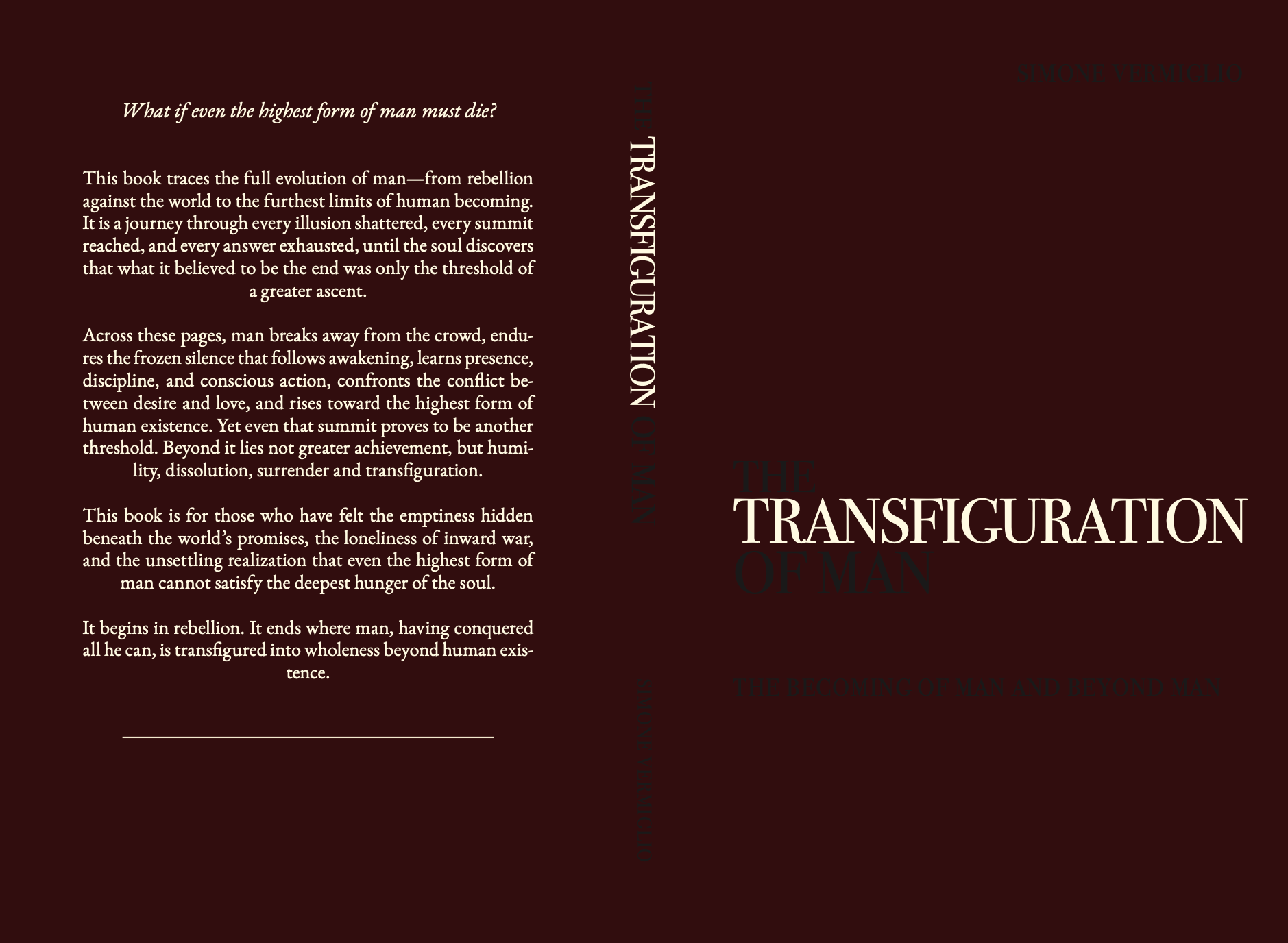
A philosophical, psychological and spiritual journey through the transformation of man.
Across five parts, the work moves from rebellion and solitude to consciousness, power, love and desire — before confronting the limits of human strength and the meaning of surrender to God.
As man transforms, the nature of the book transforms with him. Each part opens a different dimension of the same inquiry: what can man become, and what lies beyond him?
English Edition
283 pages
5 PARTS
14 × 21.6 cm
YOU WANT A BETTER VERSION OF YOURSELF?
BECOME ALL THAT MAN CAN BECOME. THEN DARE TO DISMANTLE HIM.
ONLY THEN DOES THE FINAL AND HIGHEST TRANSFORMATION CAN BEGIN.
THE FIVE
TRANSFIGURATIONS
Five moments through the becoming of man—and beyond him
THE EVOLUTION OF
MAN
Modern self-development teaches man to improve himself endlessly.
But improvement is only the beginning.
The real question is how far man can transform himself — and what remains when he reaches the highest form he can create by his own strength.
THE ASCENT. THE DESCENT. THE THRESHOLD.
THE REBEL
The first evolution begins when a man refuses to remain the product of values, ambitions and fears he never chose.
NIETZSCHE’S ÜBERMENSCH
Freedom is only the beginning. The rebel must overcome himself, create his own values and rise toward a higher form of human existence.
THE HIGHEST MAN
Self-overcoming becomes creation. Through consciousness, discipline, will and mastery of desire, man reaches the furthest form he can build by himself.
THE MAN IN CHRIST
In Christ, man is transfigured into a higher form of being — beyond the limits of the earthly self.
TWO DIFFERENT
VISIONS
OF
HUMAN GREATNESS
INHERITED VALUES
THE HIGHEST MAN
Questions what he inherited and consciously chooses what deserves to remain.
NIETZSCHE’S ÜBERMENSCH
Overcomes inherited morality and creates new values.
SELF-OVERCOMING
THE HIGHEST MAN
Self-overcoming leads to the limits of human self-sufficiency.
NIETZSCHE’S ÜBERMENSCH
Self-overcoming is an expression of life's creative and transformative power.
SOURCE OF MEANING
THE HIGHEST MAN
Man develops his own understanding of meaning, then confronts the possibility of a meaning beyond himself.
NIETZSCHE’S ÜBERMENSCH
Meaning and values are created and affirmed within earthly existence.
POWER & MASTERY
THE HIGHEST MAN
Mastery of the self reveals a deeper question: whether man should remain his own ultimate authority.
NIETZSCHE’S ÜBERMENSCH
Self-mastery serves the creation of values, the cultivation of strength, and the affirmation of life.
FINAL HORIZON
THE HIGHEST MAN
The highest human achievement becomes the threshold of surrender and transfiguration in Christ.
NIETZSCHE’S ÜBERMENSCH
The Übermensch affirms earthly existence without appealing to otherworldly transcendence.
THE QUESTION
NIETZSCHE ASKS:
How does man overcome himself?
THIS BOOK ASKS:
What comes after self-overcoming?
He sought the highest form of man and found instead the end of man before God.
Simone Vermiglio
ABOUT THE AUTHOR
SIMONE VERMIGLIO
I wrote THE TRANSFIGURATION OF MAN at nineteen and twenty, but the questions that produced it had begun years earlier. Like many people of my generation, I became fascinated by self-improvement. I wanted discipline, independence, strength, confidence and greater control over the direction of my life. I believed in the possibility of consciously transforming myself, and I still do.
The problem was that some of it worked.
The more capable I became of changing myself, the more disturbing another question became: if I could consciously construct the man I wanted to become, who had constructed the man who wanted those things in the first place? I knew what I called success, what I admired, what I feared becoming and what kind of man I believed I should be. What I did not know was how many of those desires had actually originated with me.
I had begun trying to become the author of myself only to discover that someone had already written the opening pages. Or, in the language I would later use throughout the book, before I had learned to rule myself, the throne was already occupied.
So I rebelled — not against everything I had inherited simply because it had been inherited, but against its right to govern me without first being examined. Approval, expectation, comparison, the crowd: I wanted to discover what remained when their authority was removed. And with every authority I removed, I felt freer.
The less I needed approval, the less rejection could govern me. The less I needed to be understood, the less solitude frightened me. The less emotionally dependent I became on what existed outside me, the less power the world appeared to possess over what happened within. There is something intoxicating about becoming increasingly difficult to hurt; every vulnerability eliminated resembles another chain broken.
Until you discover that the same door through which suffering enters is often the door through which life reaches you.
I pursued independence far enough to encounter its corruption: detachment. I pursued detachment far enough to experience something colder still — periods in which I barely felt anything at all. The world had become less capable of hurting me, but also less capable of reaching me. I had removed the old rulers without discovering what deserved to replace them.
I had mistaken an empty throne for a free kingdom.
That discovery changed the direction of the pursuit. Rebellion could tell me what no longer deserved authority over me, but it could not tell me what should govern me instead. Destruction could clear the ground, but no man can live forever among ruins. If unconscious forces had participated in constructing the person I was, I began to wonder whether consciousness could participate deliberately in constructing the person I would become.
My attention turned toward consciousness, identity, repetition, strategy and deliberate action. My life, meanwhile, carried me from Italy to the United States, then Dubai and eventually Paris. Each world offered a different picture of what a successful man should desire, and moving between them made something increasingly difficult to deny: many of the truths through which we construct our lives feel universal only because we have never stepped outside the world that taught them to us.
Changing worlds became, in this sense, an experiment in identity. I could observe which parts of myself weakened when the environment that sustained them disappeared, which survived, and which could be deliberately strengthened. I was no longer interested only in discovering who I was. I wanted to discover how much of who I would become could be consciously chosen.
The throne was no longer something I wanted merely to empty. I intended to occupy it.
But sovereignty eventually led me into a territory where the modern world seemed profoundly confused: love and desire.
My own experiences made the question personal, but what interested me soon became larger than my own relationships. I began looking at the way my generation had been taught to desire. We had more choice, more visibility and more opportunities to be desired than ever before, yet none of it seemed to have made us better at loving. We had learned how to attract, compare and remain available to possibility — but far less about how to choose, remain and give something enough depth to become sacred.
Modern man wants intimacy without vulnerability, desire without discipline, freedom without loneliness and love without the death of alternative possibilities. He wants to be known by one while remaining desirable to many. Even another human being can become a mirror through which he measures his own value rather than a soul he truly encounters. We have become rich in stimulation and poor in reverence.
Yet I could not accept the opposite solution either. I already knew where absolute detachment led. To suppress desire, become untouchable or need nothing was not mastery. It was another form of escape.
CAN A MAN BURN WITHOUT BOWING TO THE FIRE?
That became the deeper question. Desire did not need to disappear. Beauty could still move me, love could still expose me, instinct could still burn. The test was whether intensity deserved authority simply because it was intense — whether what burned within me would become my ruler, or whether it could be placed beneath what I had consciously chosen to hold sacred.
I began to understand that a man is not free because nothing in him burns. He is free when what burns no longer governs what he serves. Yet the greatest contradiction was still waiting. I had spent years asking what deserved to sit on the throne. Not society, not approval, not fear, not desire. Eventually, my answer had become the conscious man himself.
Then I moved to Dubai.
But the greatest confrontation was not with the world around me. It was with myself. The deeper I questioned my existence, the more the identity I had spent years constructing began to collapse. Thought after thought, certainty after certainty, I found myself facing a destruction that neither reason nor will could reverse.
I had spent years learning to possess myself, only to reach a moment in which I could no longer hold myself together.
And it was precisely there, where my own strength had reached its limit, that something beyond my understanding entered what remained of me. For the first time, surrender was no longer a philosophical possibility, but a reality I had experienced.
WHAT IF THE THRONE WAS NEVER MINE?
Christ forced me to reconsider the meaning of everything that had come before. Perhaps rebellion had been necessary. Perhaps the throne first had to be reclaimed from the crowd, fear, desire and unconscious inheritance. Perhaps man had to learn to possess his own will before surrendering it could possess any meaning at all. A man who cannot govern himself does not necessarily become holy by calling his helplessness surrender.
I had spent years becoming strong enough to belong to myself. God confronted me with the possibility that belonging to myself had never been the final purpose.
The journey had begun with the discovery that others were sitting on the throne. It continued with the attempt to empty it, and then with the determination to occupy it. Only after learning to rule myself could I confront the possibility that the highest act of sovereignty might not be to remain seated forever, but to kneel willingly before God.
I did not build THE TRANSFIGURATION OF MAN by dividing human existence into five convenient subjects. Its five movements emerged from a single question pursued until every answer exposed its own limit. Self-improvement led me to question the self I was improving. Rebellion led me to the limits of detachment. Detachment forced reconstruction. Self-mastery led me into desire and love. And once I had learned to govern the self, I was finally forced to ask whether the self was ever meant to be its own final authority.
Every answer became the next question.
What began as an attempt to understand my own transformation gradually became something larger: an attempt to trace the evolution of man himself.
I did not write because I believed my life had given me every answer. I wrote because it had made these questions impossible for me to escape.
WHO IS SITTING ON YOUR THRONE?
Before you ever decided who you wanted to become, something had already begun deciding for you.
Your family gave you values. Your environment gave you standards. Society gave you definitions of success and failure. Other people taught you what deserved admiration, what deserved shame, what made a man desirable, powerful, respectable or worthy. And because most of this entered you before you possessed the consciousness to question it, eventually you stopped hearing these influences as voices from outside.
You began hearing them as your own.
This was the first problem that obsessed me.
JESUS CHRIST IS NOT MERELY RELIGION.
HE IS THE PSYCHOLOGICAL CONSEQUENCE OF SELF-IMPROVEMENT PURSUED TO ITS ULTIMATE CONCLUSION.
Simone Vermiglio
Why this book exists
I WENT LOOKING FOR THIS BOOK BEFORE I EVER THOUGHT OF WRITING IT
I — A RESTLESS MIND
I have always had a restless mind.
Not necessarily because something was wrong, but because I found it difficult to leave certain questions alone. An ordinary experience could remain in my mind long after it had ended, slowly becoming a question about identity, society, desire, love, ambition, morality or God. And once a question entered deeply enough, I found it almost impossible to accept an answer simply because it was the one most people had learned to live with.
Over time, those reflections became increasingly difficult to express in ordinary conversation.
Some were too uncomfortable. Others too provocative. Some questioned things that modern life had made so normal that questioning them at all could sound strange. I found myself thinking about why we call certain desires our own, why being wanted can become more important than loving, why independence can turn into emotional absence, why freedom is so often confused with the absence of restraint, and why a generation obsessed with becoming itself rarely asks what the self is ultimately for.
These were not thoughts I could force into ordinary conversations without diminishing what I was trying to understand.
And a mind does not become quieter simply because it has learned to remain silent. I needed somewhere for these questions to go.
Writing became that place.
It allowed me to take what existed inside me as fragments — contradictions, observations, doubts, convictions — and remain with them long enough to discover where they actually led.
THE TRANSFIGURATION OF MAN began, in part, because I needed to give form to what I could no longer leave unexpressed.
II — THE FRAGMENTS
I have rarely chosen books simply because they were famous or because someone said they were worth reading. I looked for books according to what I needed to understand at a particular moment of my life.
When I wanted to understand discipline, I searched for discipline. When my questions became psychological, I searched psychology. When they became philosophical, I searched philosophy. When they entered love, desire or faith, I followed them there.
I began to think of books as fragments.
A book does not need to explain your entire existence to change it. Sometimes it gives you precisely one idea you were missing at precisely the moment you were capable of understanding it. You take that fragment, carry it into your life, and eventually another question appears.
So I kept searching.
But at some point, I realized that what I was looking for was no longer another fragment.
I was looking for the transformation that connected them.
The movement from inherited identity to rebellion. From rebellion to isolation. From isolation to conscious self-mastery. From mastery into desire and love. And finally, from the highest possibilities of the self toward the question of whether the self was ever meant to be the final destination.
I found extraordinary fragments across philosophy, psychology, literature, self-mastery and faith.
What I could not find was the journey between them.
The world had not failed to give me answers.
What remained silent was the space between them.
THE TRANSFIGURATION OF MAN was my response to that silence.
THIS BOOK ASKS MORE OF YOU THAN TO UNDERSTAND IT.
IT ASKS YOU TO CONFRONT WHAT MADE YOU, MASTER WHAT GOVERNS YOU, REACH THE FURTHEST LIMIT OF WHAT YOU CAN BECOME — AND THEN TRANSCEND THE LIMITS OF MAN HIMSELF.
BE THERE WHERE IT BEGINS
Leave your email to be notified when THE TRANSFIGURATION OF MAN becomes available.
Your email will be used exclusively to notify you of the book’s release. No advertising or promotional communications will be sent.
FAQ
-
THE TRANSFIGURATION OF MAN follows a single question to its furthest consequence: how far can a human being consciously transform himself?
The journey begins with the identity man inherits before he is conscious enough to choose it. It moves through rebellion, solitude, consciousness, self-mastery, desire and love, following each transformation until it reveals both its power and its limit.
But the book does not end with the creation of a stronger, more independent or more sovereign man. It asks what happens when man reaches the highest point of becoming available through his own strength — and discovers that even the self he has spent so long learning to master may not be the final destination.
The journey begins with becoming yourself. It ends by asking what lies beyond yourself.
-
Not in the conventional sense.
Most self-improvement begins by asking: How can I become better?
THE TRANSFIGURATION OF MAN asks a more uncomfortable question first: Who defined what “better” means to you?
Before teaching man to strengthen the self, the book examines the forces that helped construct that self: society, approval, fear, inherited values, unconscious desire and the need to belong.
From there, it does pursue transformation — discipline, consciousness, independence, self-mastery and deliberate action matter deeply throughout the book. But it refuses to assume that becoming more powerful is the final purpose of becoming.
This is not a manual for optimizing the person you already are. It is an inquiry into how far that person can be transformed.
-
It becomes one — because the journey eventually demands it.
The book begins with man and follows human becoming as far as man can carry it by his own strength. He questions what shaped him, frees himself from inherited authority, survives solitude, develops consciousness, masters himself, confronts desire and learns to love without becoming enslaved by what he loves.
By the end of this ascent, man has not failed.
He has succeeded.
He has become all that man can become through his own will, consciousness and strength. And precisely there, at the highest point of human sovereignty, the central problem of the book changes.
If man wishes to continue evolving, how can he go beyond man while remaining entirely within man?
Another act of discipline would still be human. Greater knowledge would still be human. Greater control, greater power, even a more perfected self would remain transformations occurring within the same boundary.
To move beyond that boundary, the direction of becoming must change.
This is where Christianity enters the book — not as an interruption of the journey, but as its final evolution. The man who spent the previous movements learning to free, construct and govern himself must now confront the possibility that the highest form of becoming is no longer the expansion of the self, but its willing surrender to something higher than itself.
Man had to become all that he could become before he could confront what he could never become by himself.
The final movement therefore turns explicitly toward God and Jesus Christ. Not because the human ascent was meaningless, but because it had finally reached its limit.
Christianity begins where becoming more of man can carry man no further.
-
No.
You do not need to believe in the destination before beginning the journey. You may be Christian, atheist, agnostic, or simply uncertain. The book does not ask you to accept its conclusion before confronting the questions that produce it.
For most of the journey, the challenge is human: what shaped you, what governs you, how far consciousness can transform you, whether desire can be mastered, whether love can coexist with sovereignty, and what the highest form of human becoming might look like.
Christianity enters only when that ascent reaches its limit. You are free to reject the conclusion when you reach it. But rejecting it does not remove the limit that produced it.
If man has become all that he can become through his own consciousness, discipline and strength, then becoming more man cannot take him beyond man. The final transformation must demand something fundamentally different: not another conquest of the self, but the transcendence of the self that has been doing the conquering.
You do not need to be Christian to enter this journey.
But if you cannot yet see Christianity as the final evolution of man, perhaps that is precisely why you should follow the journey to its end.
-
For the person who refuses to live beneath what he is capable of becoming.
For those who seek discipline, strength and independence, but know that achievement alone cannot represent the highest possibility of a human life. For those willing to question what shaped them, master what governs them, confront desire without becoming its servant, and pursue their evolution to its furthest limit.
It is for the person who feels that remaining less than he could become would mean betraying the height of his own soul.
If you are unwilling to settle for the man you inherited, this journey was written for you.
-
It does not treat the different dimensions of human transformation as separate lives.
Philosophy can teach us to question inherited values. Psychology can expose what operates beneath conscious thought. Self-mastery can teach discipline and deliberate action. Reflections on desire can illuminate love and attachment. Faith can confront the meaning and limits of the self.
But the same human being must live through all of them.
THE TRANSFIGURATION OF MAN follows that human being continuously. Every solution produces the conditions for the next problem: rebellion produces freedom, freedom risks becoming detachment, detachment demands reconstruction, self-mastery encounters desire and love, and sovereignty eventually confronts the question of God.
The book therefore changes as the man within it changes.
It does not offer another fragment. It attempts to trace the transformation connecting them.
-
Because no transformation of man exists in isolation.
Philosophy can free a man from inherited beliefs, but that freedom inevitably has psychological consequences. Once the old identity has been dismantled, man cannot remain empty; he must consciously reconstruct himself, choose what deserves to govern him, and pursue what he believes his life should become.
But even the most disciplined and sovereign man remains incomplete if he cannot master desire without destroying it, and experience pure love without becoming enslaved by what he loves. Strength without the capacity to love cannot represent the highest form of man.
And even that highest man eventually reaches the boundary of what human strength can accomplish. If his evolution is to continue beyond himself, self-mastery must ultimately give way to transfiguration — and man must confront God.
The book moves through philosophy, psychology, self-mastery, desire, love and Christianity because man himself must move through them to become whole — and finally, to become more than man alone can make of himself.
-
Expect to be taken to the furthest limits of your own becoming.
Through rebellion, solitude, consciousness, self-mastery, desire, love and faith, the book confronts each boundary that stands between the man you inherited and the man you are capable of becoming.
But becoming the highest version of yourself is not where the journey ends.
The final purpose is not to understand the transfiguration of man — but to carry your own becoming so far that transfiguration becomes inevitable.
CONTACT
General inquiries
Press & media
Review copies
thetransfigurationofman@gmail.com
FOLLOW
SIMONE VERMIGLIO
Author of THE TRANSFIGURATION OF MAN
© 2026 Simone Vermiglio. All rights reserved.